
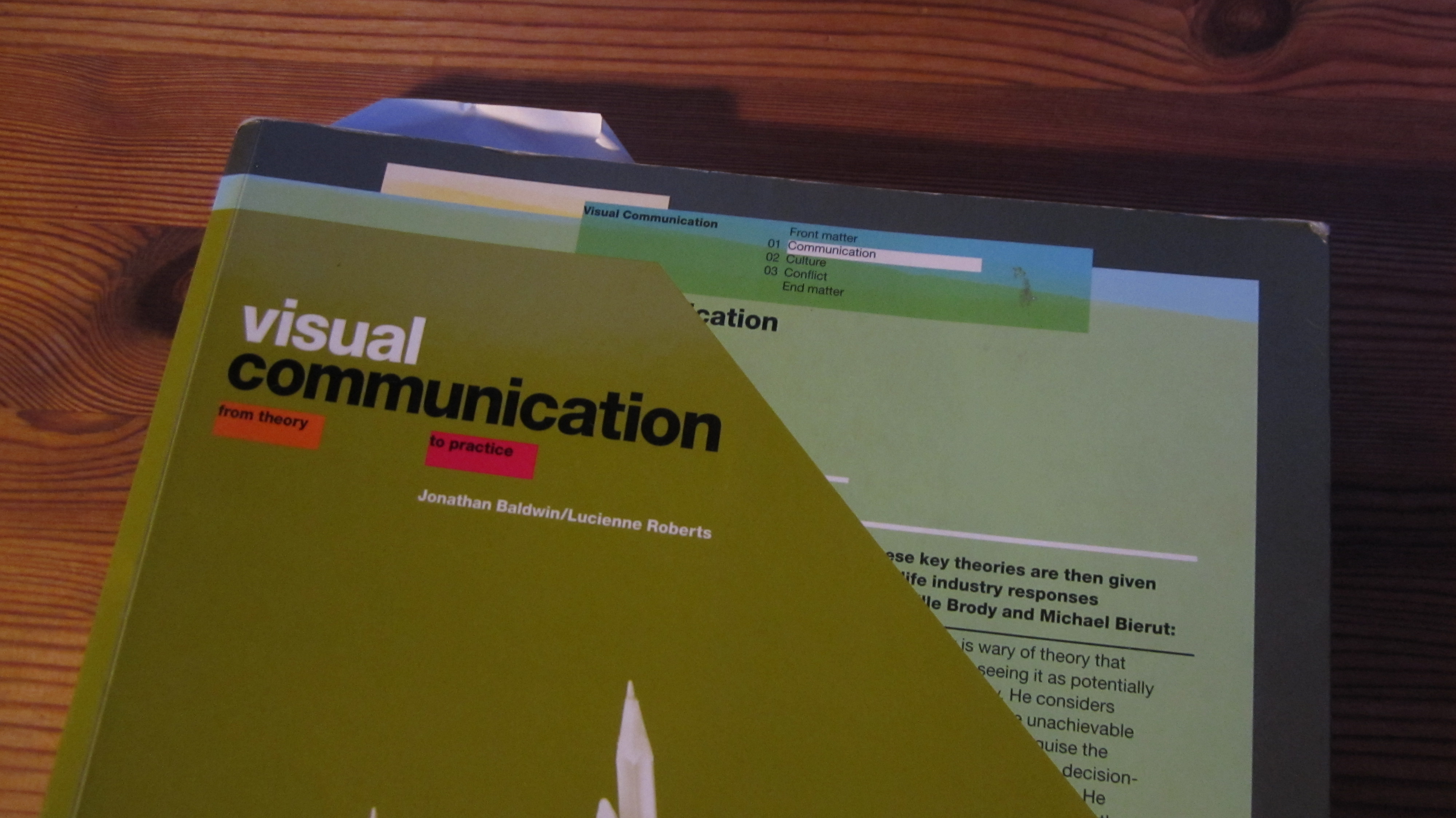
 At the moment I’m reading Visual Communication from theory to practice by Baldwin & Roberts. It’s a wonderful mix of communication theories, insightful comments from famous design practitioners, and illustrative examples of graphic design.
I’m seriously considering buying this book for my sofa-table, you should too.
The book is parted up in three sections, each combining a theoretical introduction with comments/application by practitioners, summary:
Design as communication
- Introduction to Shannon & Weaver’s communication model (yes, very basic, but probably a good starting point for designers), plus semiotics and the construction of meaning (yay!).
- Neville Brody criticizing the theories as constraining pseudo science and suggesting more personal guidance of students instead of teaching rules.
- Michael Beirut agreeing that design is essentially communication but that the pseudo science in graphic design is caused by designers knowing too little of the theory and make something up as they go along to rationalize the solutions after the fact.
Design as culture and consumption
- Segmentation, highbrow/lowbrow culture, popular culture and consumerism, identity creation, appropriation of counter cultures in the fashion cycle, etc.
- Joan Farrer discussing the UK fashion industry, design process based on heavy market segmentation, economies of scale versus experimentation, and price versus ethics.
- Shin Azumi & Tomoko Azumi: Democratization of good design via mass production, design process based on functionality and longevity, segmentation leads to mediocre design.
Design as conflict
- All design is political, handling unethical design-work in a capitalist society, anti-brand movements, the threat from amateur designers, Bourdieu and the construction of the design field.
- Erik Spiekermann discussing the relationship between designer and customer, public versus private customers, balancing ideals and earning money in a capitalist society,
- Emmi Salonen wanting to help people through graphic design, criticizing the fight for designer stardom, realization that voluntary and public sectors are still markets, working for money while volunteering on the side as a solution.